Befriending the Voices Inside

Julia Fry
2026
Anxiety is often spoken about as a problem to be fixed, medicated, or mindset-hacked away. Yet in the therapy room and in my own life, anxiety has shown up as something more complex: a protective part, a messenger from deeper hurt, and sometimes a sign that something stranger is moving through the nervous system. In this article, I share my journey with gremlins, inner critics, parts-work and “critters”, and how creativity and compassion help us move from fighting ourselves to befriending what lives inside.
This is written for anyone who feels hijacked by anxiety or critical voices and is curious about a gentler, more creative way of relating to them.
Meeting the Gremlins
When I trained as a coach in 2005/2006, I met my ‘gremlins’- five subconscious saboteurs tripping me up in life or goals. The ‘Hurry Up’ and ‘Perfectionist’ were most prominent (I don’t remember the other three).
In 2007, The Artist’s Way introduced my ‘Inner Critic’. I got to know her intimately. I realised she wasn’t me, just a part hogging my mental space.
Merging these concepts revealed multiple critical ‘parts’ speaking in my voice, each feeling like the whole me. Awareness of these parts unsettled me at first. Available information pathologised it as mental illness. I felt fragmented.
Breakdown to Sage
I entered a breakdown and asked for psychotherapy through my GP, who gave me pills and referred me for CBT instead. I turned to art. It was there I met my Sage: the compassionate core.
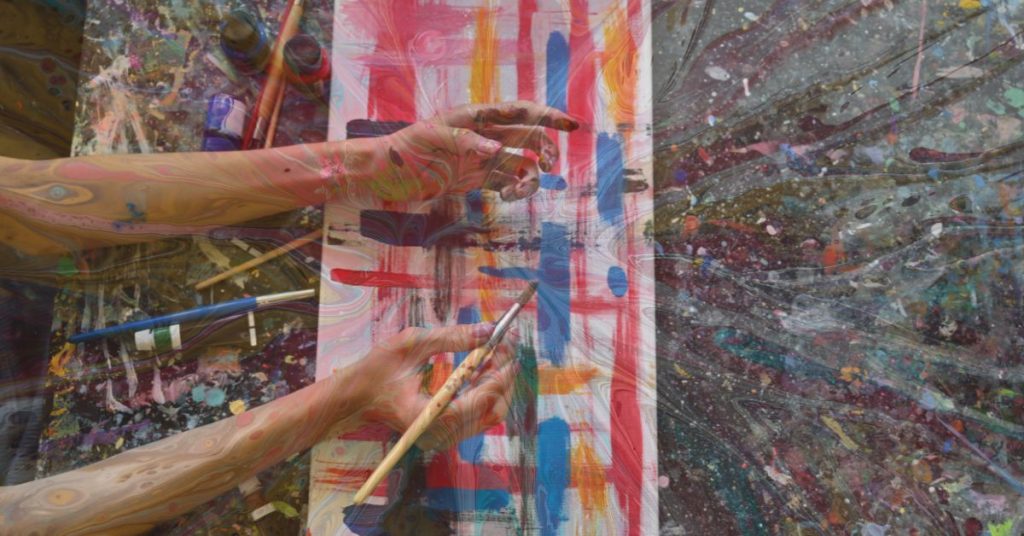
Painting taught me I didn’t have to obey every thought. It freed me from the parts’ tyranny, letting me simply notice the qualities of the thoughts. As I painted dot after dot on my canvas, I found my nervous system relaxed. Over 5,000 studies from 2025 alone confirm: creativity calms the nervous system (Google Scholar).
Painting and other forms of creativity help parts of the self express without words. If we can relax our inner critics enough to use art materials, we can make something that imperfectly, yet beautifully, expresses what they need to share. Then, if necessary, it can be symbolised in words. There’s something deeply satisfying about two people looking together with love at a creative expression (I offer this in therapy).
Creative, intuitive play taps into the subconscious, and gives space for parts that feel ready to emerge to be seen. Richard C. Schwartz created a therapy methodology – Internal Family Systems (IFS) – around the concept of parts and the ‘Self’ that holds them. My Sage and Saboteurs work is similar.
I experienced my Sage (or what Schwartz calls the ‘Self’) before I understood what it was. It was developed from my experience of coaching, but has been part of the nervous system since before birth. Being so present, for the good of the other, in coaching conversations gave space for the compassionate core of me (Sage) to expand.
Anxiety’s Hidden Layers
Schwartz talks of various kinds of parts in IFS: some have roles – protector, manager, or firefighter. Some are vulnerable parts taken care of by the ones with roles. This system exists within the Self, which, like my ‘compassionate core’ or Sage is deeply loving towards the other parts. However, when the parts with roles are activated they ‘blend’ with the Self so it feels like that (often critical) part is the whole self.
I see the Sage or Self as the bridge, connecting body/psyche to others, Nature, and even spirit realms. It’s a model that describes duality – separate, yet connected. How does this model help us in everyday life?
Enter anxiety: a common ‘problem to be fixed’. It’s all over social media as a symptom of mental ill health. From a ‘parts’ lens, anxiety is a protective or managing part that hides a vulnerable or hurt part, whose feelings have been repressed or suppressed. When this vulnerability is given safe space, it can unburden itself, but without that, it needs the protective part being anxious to guard it. So many people continue to feel anxious because they’re not taught that anxiety hides other feelings. (I find this question useful when I feel anxious: what’s underneath this feeling of anxiety?)
Sometimes, however, anxiety signals ‘critters’ – IFS term for malevolent entities invading the nervous system. I discovered them in Derek Scott’s book, Dead (Spoiler Alert) A Psychotherapist’s Journey with Cancer, in which he shared his experience of learning IFS.
Sounds wild? Schwartz downplays critters publicly for good reason. Yet shamanism, Buddhism, Christianity, Islam, Hinduism, Paganism, and many Indigenous traditions all recognise them, and use ritual for release.
Few therapies (IFS, Spirit Release) treat them as real; Western medical models pathologise people showing up with them. Derek Scott’s critter hissed, “Kill the baby”, echoing ‘schizophrenic’ voices. I wonder whether pathologising people as ‘schizophrenic’ makes those voices stronger.
Schwartz deals with critters by asking if they are part of the person’s system. They seem to honestly state, “No,” so he tells them to leave – to go to the ancestors who await them with love. What beautiful work!
Key caveat: if you mistake a part for a critter and banish it, dysregulation hits the system. This makes sense when you understand that all parts – even saboteurs – mean well. I learned this the hard way.
The Walk That Changed Everything
Many years ago, I hunted my ‘inner critic’ to get rid of it. I thought I’d done it. Elated, I went out for a walk. My steps were light and I felt fantastic, smiling at strangers. I’d nailed it! Then anxiety gripped my heart and my stomach dropped.
Self-consciousness surged! Everyone could see me! I hadn’t nailed it at all. I’d pushed ‘it’ outside me and now everyone was judging the way I looked, walked, breathed (that’s how it felt). I was a 15 min walk from home and it felt like an ordeal to get there, trudging through shame.
At home I studied a drawing I’d made before my walk. I’d made it with my non-writing hand to access my subconscious, but hadn’t noticed a particular detail. There, in a green scribble, was my inner critic, looking over his shoulder, eye glinting mischievously at me. I felt relieved to see it, which might seem strange.
Realising that I couldn’t get rid of it was a turning point. I began to befriend it instead. It was the beginning of appreciation for that ‘gremlin’ and a softening in the way we related to each other. My Sage (Self) got me home to see and acknowledge the inner critic I thought I’d killed, but actually came back bigger and stronger.
Dancing with Parts
What you resist persists. Acceptance is key for working with parts. The other night I was dancing in a club and I suddenly felt a familiar contracting, followed by a certainty that the couple nearby were talking about me and laughing at my dancing. It felt so real. It felt like the only way of perceiving for a while and I kept dancing, feeling antagonistic towards the couple. I had the sudden thought that it was a part thinking that, and I could accept it and bring it to my heart. Everything changed, including how I felt towards the couple: more loving.
Befriending my inner critic, acknowledging my anxious parts, and respecting even the possibility of “critters” has not made life neat or tidy. What it has given me is a way to stay with myself – through painting dots on a canvas, dancing in a club, or sitting with a client – without making any part of me an enemy. If any of this resonates, you might experiment with a small act of creativity the next time your nervous system feels crowded: a scribble, a few words, a movement. Let the part express, and see what happens when, instead of trying to banish it, you simply meet it with as much Sage or Self as you can find in that moment.
If you’d like support getting to know your own parts with creativity, compassion and curiosity, you’re welcome to contact me to explore therapy or coaching together: